
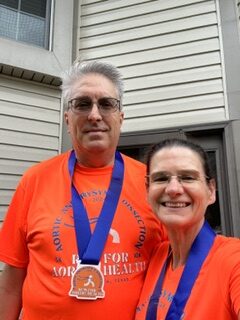
In the aftermath of her husband Chris’s aortic dissection, Heidi Underwood had no plans to give up.
Chris was in a coma, and Heidi kept waiting for him to wake up.
“I remember taking his glasses with me every day, thinking, ‘Today he’s going to wake up and he’s going to want his glasses,’” she said. “And he didn’t wake up and he didn’t need his glasses.”
Eventually, Heidi stopped bringing them.
Then, one morning, she arrived to find that an overnight nurse had shaved Chris.
“I [had] felt like I had to fight for them to see him as a human being,” she said. “[The overnight nurse] saw him as a human and not just as a patient in the bed.”
Someone else was still caring for Chris as Chris. For Heidi, that simple act helped restore some of the hope that had begun to slip away.
“It was so special. He just went above and beyond.”
She later nominated the nurse for a DAISY Award. And eventually, Chris woke up.
For both Chris and Heidi, though, surviving the emergency was only the beginning.
During Aortic Dissection Awareness Week, The Marfan Foundation and its division, The VEDS Movement, are shining a light on an often less-visible part of surviving an aortic dissection: the impact on spouses, partners, caregivers and families.
In Heidi and Chris’s case, that story began on July 24, 2019, with plans for an ordinary summer evening.
“We had tickets to a concert that evening,” Heidi remembers. “I had won them at a radio station contest.”
Heidi was getting ready when Chris’ boss called. Chris was at work and having chest pain. They were taking him to the hospital to get checked out.
“That started a chain of events,” Heidi said.
Chris had experienced an aortic dissection. He was airlifted to Albany Medical Center for emergency open-heart surgery and required another open-heart surgery the following day. His recovery became even more complicated by heparin-induced thrombocytopenia. He ultimately lost the front portions of both feet.
He spent about 35 days in intensive care, another four weeks in rehabilitation and later returned for additional procedures. He would be out of work for approximately a year.
“It was very difficult to watch,” Heidi said.
“It is always a balance”
Making it through the immediate crisis was just the beginning for Chris — and for Heidi.
Recovery brought a different challenge: figuring out how to care for the person she loved without taking away his independence.
“I feel like I need to protect him, but I also don’t want him to feel like I’m protecting him,” Heidi said. “And so it is always a balance.”
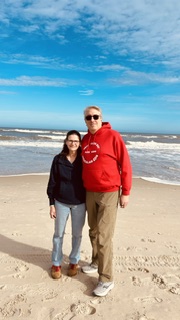
There were things Chris could no longer safely do. When the couple lived in upstate New York, shoveling snow became Heidi’s job. So did carrying some of the heavier things that once would have been Chris’.
And people didn’t always understand what they were seeing.
“Why are you letting your wife? Why is she carrying the big bags of rocks?” Heidi remembers people wondering.
Medication brought its own challenges.
When Chris first returned home, Heidi administered IV antibiotics three times a day. After being responsible for so much of his care for so long, letting go didn’t come easily.
“I remember not letting him touch [his daily medication] because I wasn’t sure he was going to do it correctly,” she said. “I think I almost became a control freak a little bit with trying to make sure everything was just perfect.”
With time, she learned to step back where she could.
“I want him to do the things he can,” she said. “I want to protect him and not make him feel bad about it.”
And sometimes caring for someone means making the difficult things look easier than they really are.
“That’s my job,” Heidi said, “to make it seem like it doesn’t bother me and that it’s easy.”
Letting the caregiver be cared for
During those first months, there wasn’t much room in Heidi’s life for Heidi.
Chris needed IV medication every eight hours. Heidi was trying to keep everything around him exceptionally clean while he waited for additional surgery. She was washing sheets constantly. She had largely stopped exercising — something that had previously become an important outlet for her.
Then Chris said something.
“I think you need to go back to the gym.”
He was right.
“I did, and that’s my release,” Heidi said.
Exercise remains the time when she can work through what she’s carrying.
“I call my workout time my filing cabinet,” she said. “I’m able to sort through my day and sort through any problems. I’m able to put things where they need to be, and then I feel better.”
There was another form of self-care Heidi had an even harder time accepting: letting other people take care of her.
While Chris was in the ICU, life outside the hospital didn’t stop. There was a house, a large yard, a pool she didn’t know how to maintain and dogs that needed to be fed.
People offered to help. Heidi resisted.
“I hated taking that help because I’m usually the helper, the giver,” she said. “It felt really weird to have people offer.”
Eventually, she simply couldn’t do everything.
Neighbors fed the dogs. Others stepped in. And Heidi learned something she now wants every new caregiver to hear.
“First and foremost, let people help you,” she said. “Be the taker. I always pictured myself as a giver and I became a taker, but then turn it around and pay it forward and be a giver again.”
A diagnosis that reaches through a family
Chris was later diagnosed with vascular Ehlers-Danlos syndrome (VEDS). Then Heidi and Chris learned that their daughter has VEDS, too.
“That was a tough one,” Heidi said.
Their daughter hoped to become a mother, adding another layer to the emotions surrounding the diagnosis. Because she knew she had VEDS before becoming pregnant, she chose to move forward with having a baby, and received medical monitoring during her pregnancy.
Today, Heidi and Chris are Nana and Papa.
And watching Chris become Papa has brought Heidi some of her favorite moments.
Their grandson, Jack, loves garbage trucks. Heidi treasures a picture of Jack and Chris sitting together on a little brick wall in front of their house, simply watching the truck pick up the trash.
“Jack adores him,” she said. “It’s just neat to see.”
“Now it’s like a family”
The Underwoods also found another kind of family through The Marfan Foundation and The VEDS Movement.
It didn’t happen immediately.
After attending their first Marfan Foundation/VEDS Movement community event, the local Walk for Victory – where they didn’t yet know anyone – and making their way to the Marfan Foundation’s Conference: “Now it’s like a family,” she said.
For someone whose spouse, partner or child is newly facing an aortic emergency or VEDS diagnosis, Heidi’s advice is to reach toward that community rather than trying to navigate everything alone.
“Connect with this community. Find support,” she said. “The online support is wonderful. It’s like being in the room with people.”
She encourages families to use the available nurse resources, find knowledgeable doctors and build a strong medical care team.
And, she comes back to that simplest advice: “Take any help that anybody’s willing to give you.”
Finding their way forward
More than seven years after that missed concert, Chris and Heidi are still finding new ways to do the things they love. They geocache. They take on Garmin challenges. They spend time outside, bicycle and walk their dog. Chris can no longer run the races he once did, but that doesn’t keep him from signing up.
“He loves to register for 5Ks and 10Ks, and then he’ll walk them,” Heidi said. “He’s always signing up for some race.”
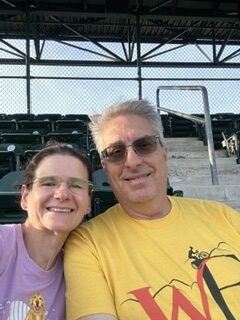
There are still things Heidi isn’t quite ready for. She hasn’t yet felt comfortable getting on an airplane with Chris since his dissection.
“We’ll get there,” she said. “I’m just not comfortable quite yet.”
Even their newest family activity has its roots in Chris’ recovery.
Their dog is now a certified therapy dog. While Chris was in rehabilitation, Heidi remembers how much he loved the days when therapy dogs visited. “I would go take him from his room and he would go visit the dogs,” Heidi said. “And so I kind of hope to be that for someone else.”
To learn more about aortic dissection, visit: marfan.org/aorticawareness
For free, no-obligation online support groups – including support groups for loved ones – visit: Virtual Support Groups – Marfan Foundation
To learn more about Vascular Ehlers-Danlos syndrome (VEDS) visit thevedsmovement.org
To be ready for VEDS emergencies, visit VEDS911.com
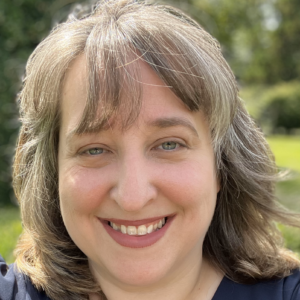
April Dawn Shinske is the Chief Communications and Marketing Officer for The Marfan Foundation. She is proud to lead a stellar integrated marketing and communications team and honored to help tell the amazing stories of our community members.