
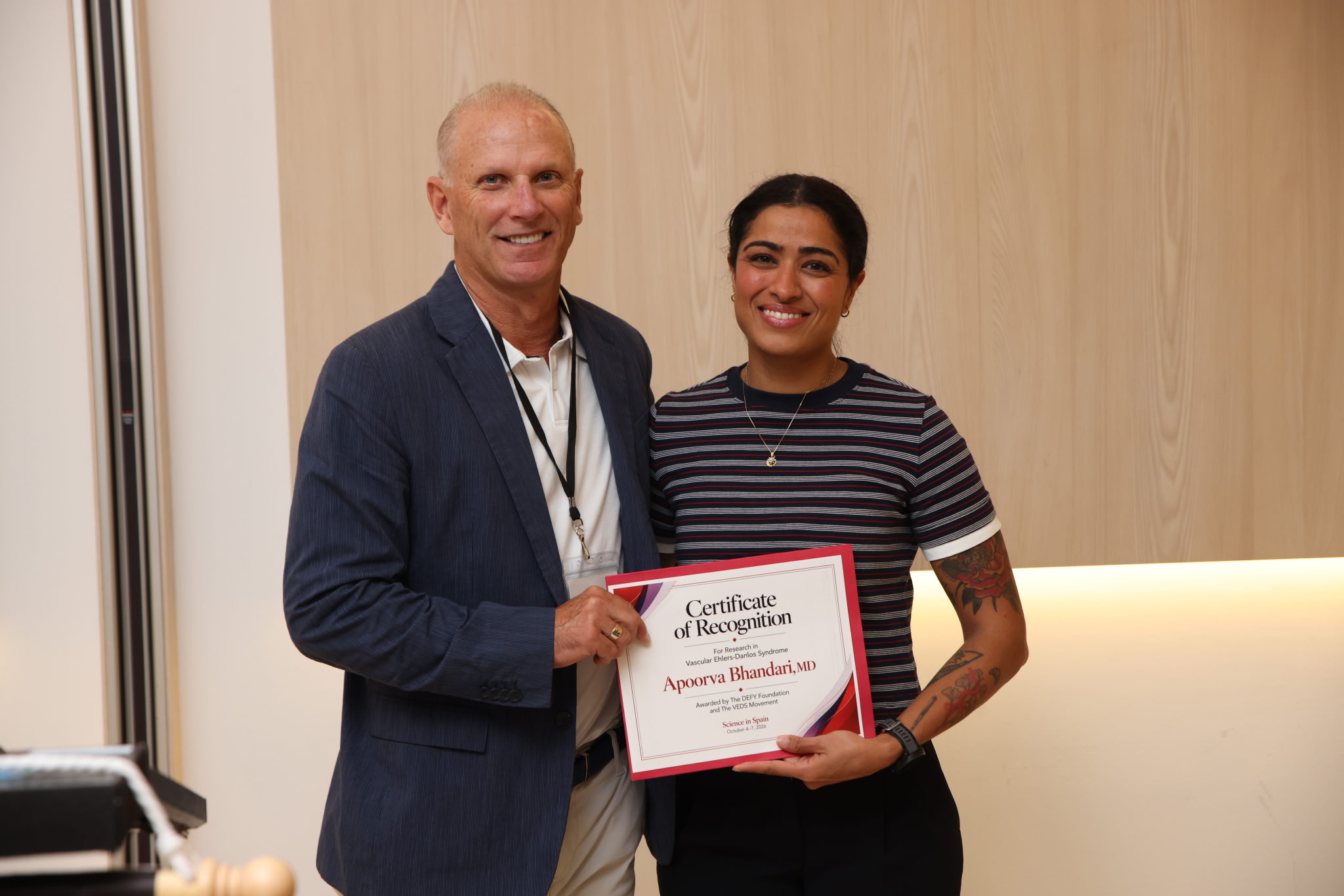
Thanks to the generosity of our community, The Marfan Foundation is convening Science in Spain, a worldwide scientific meeting with the goal of moving us toward new breakthroughs, better treatments and hope for a brighter future.
The event consists of two parts: the 12th International Symposium on Marfan, Loeys-Dietz, Vascular Ehlers-Danlos and Related Syndromes and The Genetic Aortic Network (a division of The Marfan Foundation) and the European Society of Cardiology Aorta and Peripheral Vascular Disease Joint Session.
In today’s update, we look at how researchers are trying to find ways to detect conditions and related signals sooner, understand risk more clearly and support quality of life at every age.
Science in Spain is focused on one aim: advancing scientific understanding that will ultimately help more people thrive.
Earlier Detection & Understanding Risk
Looking at the aorta’s shape, not just its size
Research presented by Yogesh Karnam, University of Wisconsin-Madison
Instead of looking only at how wide the aorta is, this study used CT scans to measure its 3D shape. In people whose aorta was still a normal size, shape measurements helped identify those who had a genetic aortic condition.
This work aims to give people with a gene change an earlier, clearer picture of their aortic risk, before the aorta enlarges.
Testing a phone app to identify conditions
Research presented by David Murdock, The University of Texas Health Science Center at Houston
Researchers built a phone app that uses AI to look at facial photos for features linked to Marfan syndrome, VEDS and Loeys-Dietz syndrome. In testing, it identified these conditions with high accuracy.
The goal of this research is to help people and families get referred for genetic testing sooner, including by doctors unfamiliar with genetic aortic and vascular conditions.
3D facial imaging on a large scale
Research presented by Benedikt Hallgrimsson, University of Calgary
Researchers built a library of 3D facial images from more than 12,000 people, processed the same way across many clinical sites. In genetic aortic conditions, early analyses suggest facial measurements may help classify conditions and assess severity.
Investigating this may show how a non-invasive 3D photo could support diagnosis and risk assessment.
An emerging genetic cause
Research presented by Carine Le Goff, Inserm
A substantial number of people with inherited aortic aneurysm or dissection have no known genetic cause. Researchers in France found changes in a gene called ADAMTS6 in four unrelated people.
Studies of patients’ cells and of experiments in mice using this genetic mutation indicate it could be the cause of a previously unrecognized connective tissue condition involving the heart, the aorta and development.
This research aims to identify genetic causes for aortic conditions that until now had no known explanation.
Life after aortic surgery
Research presented by Ernesto Calderon Martinez, The University of Texas Health Science Center at Houston
Researchers followed 229 people who had planned surgery on the aortic root or ascending aorta. About 1 in 5 later had another aortic event, and how often that happened differed by gene.
This research aims to show how follow-up treatment after surgery could be tailored to a person’s gene to prevent future aortic complications.
A heart valve difference and Loeys-Dietz genes
Research presented by Siddharth Prakash, The University of Texas Health Science Center at Houston
Among 816 people in the Montalcino Aortic Consortium registry, bicuspid aortic valve (BAV – a heart valve with only two leaflets instead of three) was more common in people with certain Loeys-Dietz syndrome genes.
The study showed that LDS individuals with BAV had an enlarged aorta at an earlier age, had earlier surgical interventions and had their first aortic event at a younger age. They did not have a higher rate of dissection.
These results may help doctors consider LDS patients with a bicuspid valve at greater risk for earlier enlargement.
Heart recovery after mitral valve surgery in children
Research presented by Simon D’hulst, Ghent University Hospital
In 31 children with Marfan syndrome who had mitral valve surgery at six centers in Europe, surgery reduced enlargement of the heart’s main pumping chamber and kept heart function stable. Heart failure after surgery remained common.
This research aims to identify which children may be at higher risk after mitral valve surgery, and to understand how their hearts recover over time.
Quality of Life
Work and daily life
Research presented by Olivier Milleron, Hôpital Bichat
In a French study of 292 adults with Marfan syndrome, 74% were working or in training. Adults who had an aortic dissection were less likely to be employed and more likely to face social and financial hardship. Planned, preventive aortic surgery was not linked to these challenges.
This research highlights how a dissection may affect work and finances, and why attention to social factors matters alongside medical care.
“None of our doctors know about this”
Research presented by Catherine Isadora Côté, Université de Montréal
In a Canadian consultation, 90 people, including people living with genetic aortic and vascular conditions, caregivers and clinicians, shared their experiences. They described gaps between published recommendations and real-world care, including limited awareness among providers.
Care for chronic pain, fatigue and rehabilitation came up as a central priority.
This work aims to bring the voices of people living with genetic aortic and vascular conditions into efforts toward more coordinated, accessible care.
Leaders & Honors
Science in Spain is also a moment to honor leaders whose work has shaped this field and contributed to community wellbeing:
Dr. Valentin Fuster is receiving the Global Vision Award for Cardiovascular Science and Medicine for his decades-long commitment to helping more people thrive.
Dr. Arturo Evangelista of Vall d’Hebron University Hospital, a member of the symposium’s planning committee, is receiving the Lifetime Achievement Award in Aortic Medicine. Dr. Evangelista also received the 2026 Antoine Marfan Award, The Marfan Foundation’s highest honor, during the patient-community symposium in Barcelona.
Dr. John Elefteriades of Yale University, who is moderating a session on modern surgical strategies across the aortic arch and thoracoabdominal aorta, is receiving The Marfan Foundation’s Distinguished Contribution to Aortic Science Award for his many years of commitment to fostering aortic health and patient care.
Jared Griffin of Annabelle’s Challenge, a member of the symposium’s planning committee, is receiving the Charging Forward Together Award from The VEDS Movement, a division of The Marfan Foundation, for his outstanding commitment to the VEDS community.
Tal Golesworthy is receiving the Innovation Award for leveraging his engineering background to create what would become the PEARS procedure – a new way of protecting aortas. Tal lives with Marfan and was the first person to have the procedure done. His work is a testament to the power of combining scientific and clinical knowledge with ideas from outside traditional medicine.
Thank You to Our Collaborators & Sponsor
Collaborators: Annabelle’s Challenge, DEFY Foundation, ESC Working Group on Aorta & Peripheral Vascular Diseases
Sponsor: Gore
Thank you to every member of The Marfan Foundation family. Your support makes research progress possible. Together, we are building a brighter future for everyone living with genetic aortic and vascular conditions.
Advisory
The information shared in this story is provided solely for informational purposes and to highlight the impact of The Marfan Foundation’s research and global collaboration efforts. It is not medical advice or treatment guidance.
Research discussed during Science in Spain may represent preliminary or ongoing work, and some findings may not yet have been published, peer reviewed, replicated, or studied in humans. The presentation or discussion of research does not represent a recommendation or change in current standards of care, nor should conclusions be drawn about the safety, effectiveness, or appropriateness of any particular medication, treatment, or other intervention.
Community members should not start, stop, or change medications, treatments, or other aspects of their care based on information shared here. Always consult your expert healthcare providers regarding your individual care.
The purpose of bringing leading scientists together from around the world is to accelerate discovery and deepen understanding—creating the collaborations and knowledge that may ultimately lead to the next breakthroughs and improved care for our community.
For media inquiries, please contact the Marfan Foundation’s Chief Communication, Marketing & Digital Officer April Dawn Shinske at brandcomms@marfan.org
To subscribe to our email list, visit marfan.org/subscribe

The Marfan Foundation drives research, education and support – and builds community – to improve outcomes, save lives and empower all people to thrive who are living with Marfan, Loeys-Dietz, Vascular Ehlers-Danlos syndromes, and related genetic aortic and vascular conditions.