
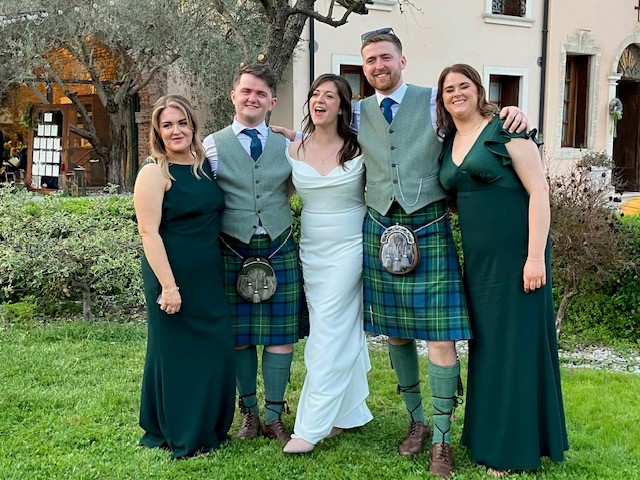
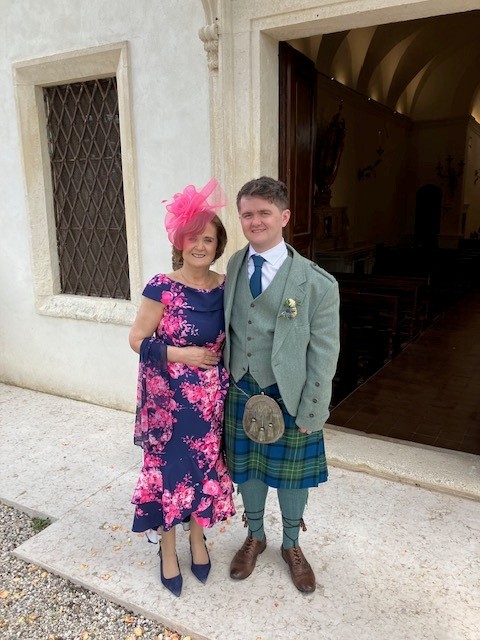
Marie Law, 63, says that in the first 20 years of her life, her “hypernasal voice” had prompted many people to ask if she has a cold. “Often, I just say, ‘Yes, I have a bad cold.’ It’s easier than explaining that I was born with a cleft palate and my voice is the result of a fistula in my palate that was left after an operation to repair the palate, to allow growth of my face during childhood/adolescent development.”
Born at home in Glasgow, Scotland, the third of four children, Marie weighed in at a whopping ten pounds, which “kept me in good stead,” she says. But within days of her birth, her mother, a nurse, noticed milk coming down Marie’s nose, after feeding. At the Royal Hospital for Sick Children in Glasgow, Marie was diagnosed with a cleft palate and Pierre Robin Syndrome, a rare birth defect characterized by an underdeveloped jaw, backward displacement of the tongue and upper airway obstruction.
Marie spent months of her first year in the hospital with numerous bouts of pneumonia and was nursed on a frame, lying on her front to help bring her jaw forward. At nine months old, she had surgery to correct the cleft palate. “Throughout my pre-school years, I had a lot of speech therapy, and I was very, very shy,” she says.
Still, Marie’s mother “had a very no-nonsense approach to life and a ‘let’s get on with it’ mindset that encouraged me to play and work hard at school and not to feel sorry for myself,” she says. At 17-years-old she began studying adult nursing (RGN), and in 1983, with a perfect three-year nursing college and placement attendance record, she was the first of sixty students in her class to be offered a permanent staff nurse job at the Victoria Infirmary in Glasgow.
After a year she moved to the Hospital for Sick Children, Edinburgh. While there, she attended a lecture by Antony Charles Harington Watson, a famed maxillofacial surgeon who became one of the key figures in the cleft palate world in Scotland. The lecture convinced her that she must have a fistula, an abnormal opening between the mouth and the nasal cavity that is the result of cleft palate surgery. Common symptoms include hypernasal speech, regurgitating food and liquid out of the nose, and whistling during speech.
In 1984 Marie had surgery with Dr. Watson to correct the fistula; she noticed immediate improvement in the clarity of her speech. She went on with her life, marrying, welcoming five children, and continuing to work part time as a nurse.
Decades later, when Marie was 45 years old, she had a frightening experience. “I was driving and it seemed like the white divider line in the middle of the road was rising up,” she says. A trip to the ophthalmologist revealed that she had advanced cataracts. The ophthalmologist began putting the pieces together — the cleft palate, her eyes, her weak hearing — and suggested that Marie should be tested for Stickler syndrome.
“I was quite concerned. I was 45, in the prime of my life, and my vision was deteriorating quickly,” says Marie. At the time, she had been working part time in a school, as a primary teacher, but felt like she needed to give up her career, as she was having difficulty making out individual pupils in the classroom setting. Going forward, to keep herself busy, she got a job in a coffee shop near where she lived, as she had now given up driving, for the safety of others and herself. “Friends would come into the shop and later ask if I was mad at them because I didn’t really recognize them and wouldn’t always say hello. The fact was I could not recognize them unless I was close to them. I didn’t like to draw attention to myself and only shared what was going on with my failing eyesight with my husband and my sister,” she says.
In 2008, when the ophthalmologist told her that “they could see that she probably had Stickler syndrome by looking at the retina in the back of my eyes,” Marie got a referral by her GP to be seen by Dr. Martin Snead at Addenbrooks Hospital, Cambridge, England. At that point, the result was not a surprise: Marie was positive for Stickler syndrome.
Due to Stickler syndrome being a dominant genetic condition, Marie also got all her children, who at that time ranged in age from 11-18, tested too. Only her eldest son, David, who is a fraternal twin, has Stickler syndrome.
In 2010, Marie had cryotherapy treatment to reduce the likelihood of retinal detachment. The Cambridge Prophylactic Cryotherapy Protocol was developed by Dr. Snead, who runs weekly Stickler clinics at Addenbrooks Hospital. “It’s quite invasive — I looked like I had gone five rounds with Mike Tyson after the operation,” says Marie. “But it secures the retina, so I was glad to have it and eternally grateful to Dr Snead for his specialist skills.” Marie received bilateral cataract surgery five months after the cryotherapy treatment. Her sight improved significantly, and she returned to teaching.
The following year – intrigued both professionally and personally – after her operations, Marie enrolled in a Master’s of Medical Genetics and Genomics program at the University of Glasgow. “I find it to be a fascinating topic, and I wanted to become a genetic counselor so I could help other people facing similar diagnosis,” says Marie, who studied this intense degree full-time while working two-night shifts on weekends as a nurse.
In the meantime, she dug into her own family history. “Dr. Snead encouraged me to bring in photographs of my parents and grandparents. It’s hard to say for sure, but we see that my mother’s father and my own mother had a slightly flattish face — like me — so it probably comes down from that side. However, there was no previous history of cleft palate in the family.”
Marie doesn’t let Stickler syndrome slow her down. In addition to teaching, she enjoys travelling with her husband and spending time with her children and grandchildren. Marie also plans to increase her volunteering with those affected by Stickler syndrome after she retires in a few years.
“What I really want individuals and families to know is that they can live full lives with Stickler syndrome,” says Marie. “I know initially it can be pretty devastating to get a Stickler syndrome diagnosis, so I’m here to listen, to encourage, and to offer hope.”
For more information about Stickler syndrome, visit marfan.org/stickler-syndrome.
Olivia Abel has been a strategic communications and editorial professional for more than 25 years. A passionate storyteller, she’s worked as a reporter at Vanity Fair and People magazines, written freelance business stories for The New York Times and spent a decade as Editor-in-Chief of Hudson Valley magazine. Olivia shares the stories of those affected by genetic aortic and vascular conditions in her current work as director of Integrated Marketing Communications at the Marfan Foundation.