
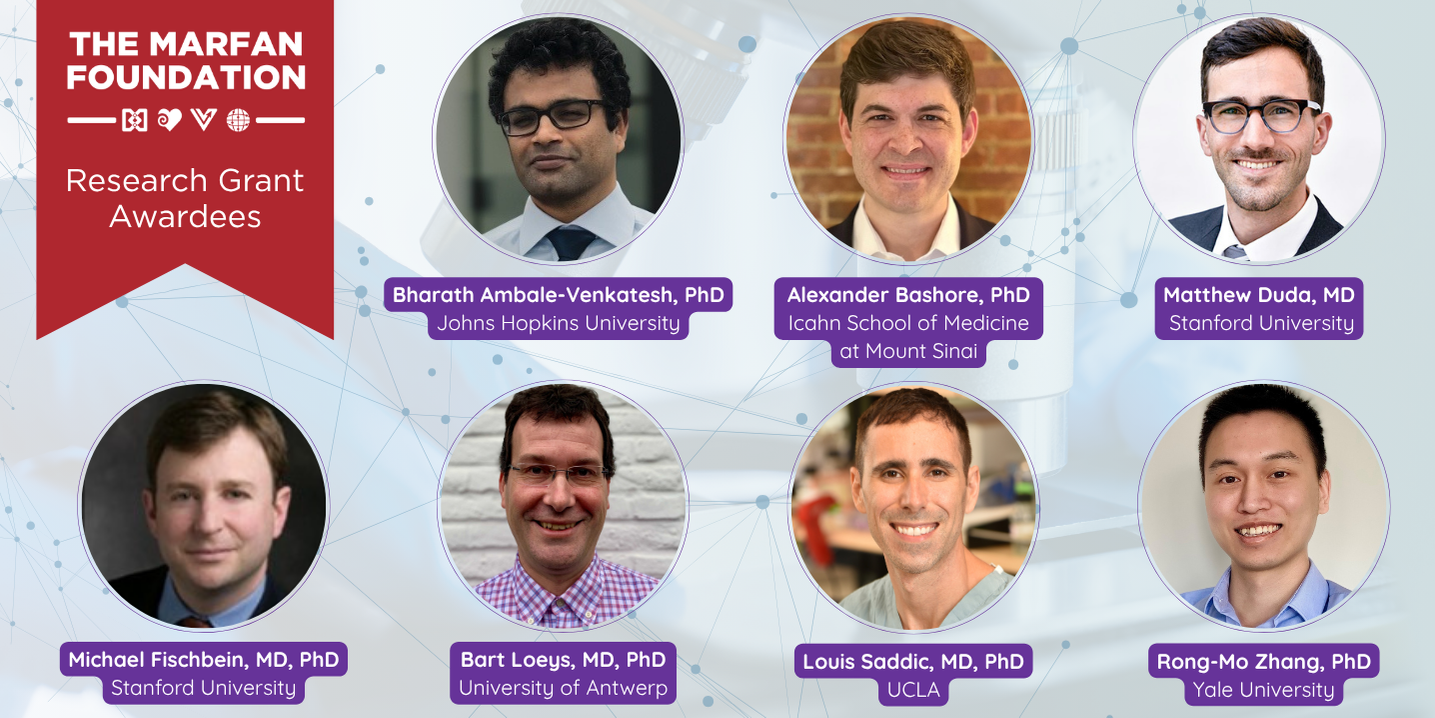
Throughout 2025, The Marfan Foundation continued its longstanding commitment to accelerating research that improves the lives of people affected by Marfan syndrome and related genetic aortic and vascular conditions. Over the course of the year, the Foundation awarded $1.44 million in research funding, supporting seven high-impact projects spanning early discovery through translational science.
Made possible through the generosity of donors, these awards include two one-year Everest Awards, two Career Development Awards, two Victor McKusick Fellowships, and one Innovator Award. Together, they reflect a strategic approach to advancing science today while building the infrastructure, talent, and knowledge needed for tomorrow’s breakthroughs.
“This year’s research portfolio reflects both depth and ambition,” said Craig T. Basson, MD, PhD, Chair of the Foundation’s Scientific Advisory Board. “Across institutions and disciplines, these investigators are applying advanced technologies to answer some of the most urgent questions facing individuals and families affected by Marfan syndrome and related conditions.”
Harnessing Technology to Predict Aortic Risk
Digital Twins for Loeys-Dietz Syndrome
Bharath Ambale-Venkatesh, PhD – Johns Hopkins University
Aortic shape and biomechanical properties as prognostic indicators in patients with Loeys-Dietz syndrome
$100,000 | 2-Year Innovator Award
One of the forward-looking projects supported in 2025 focuses on digital twin technology—virtual replicas of a patient’s aorta created using real-time imaging and biomechanical data.
Dr. Ambale-Venkatesh and his team are studying 40 individuals with Loeys-Dietz syndrome (LDS), creating personalized digital models to track how aortas change over time. These models will help train predictive software to identify who may be at highest risk for aneurysm or spontaneous dissection, potentially enabling earlier, more personalized intervention.
Unlocking the Molecular Drivers of Aneurysms
Identifying New Biomarkers Across Genetic Aortopathies
Alexander Bashore, PhD – Icahn School of Medicine at Mount Sinai
Multiomic identification of novel biomarkers and cellular pathways in thoracic aortic aneurysms
$100,000 | 2-Year Career Development Award
Dr. Bashore’s research applies advanced molecular and multiomic techniques to blood and tissue samples from individuals with Marfan syndrome, Loeys-Dietz syndrome, Vascular Ehlers-Danlos syndrome (VEDS), unexplained thoracic aortic aneurysms, and healthy volunteers.
By identifying shared and condition-specific molecular signals, this work aims to discover biomarkers that better predict aneurysm severity and progression, laying the groundwork for more precise diagnostics and targeted therapies.
“I am honored to receive a Marfan Foundation Career Development Award and grateful to the donors who make it possible,” said Dr. Bashore. “This support allows us to investigate how aortic aneurysms develop and to identify pathways that could be targeted with new therapies. Our ultimate goal is better outcomes for patients.”
Understanding Sex Differences in Marfan Syndrome
Hormones, Cells, and Precision Therapies
Matthew Duda, MD – Stanford University
Fibroblast Klf4 expression attenuates sex-specific aortic root aneurysm formation in a murine model of Marfan syndrome
$150,000 | 2-Year Victor McKusick Fellowship
Why Marfan syndrome affects men and women differently remains an important unanswered question. Dr. Duda’s project examines how gene expression in fibroblasts—a key connective tissue cell type—interacts with hormones to influence aneurysm formation.
Using a Marfan mouse model, the team is exploring how modifying gene expression and hormone exposure alters aortic structure and function. The findings may help identify precision therapies that reduce reliance on surgery.
Building the Foundation for Future Therapies
Large-Scale Molecular Mapping of Inherited Aortopathies
Michael Fischbein, MD, PhD – Stanford University
Multiomic characterization of inherited aortopathies
$220,000 | 1-Year Everest Award
(with potential for $880,000 over four years)
To enable the next generation of treatments for Marfan syndrome and Loeys-Dietz syndrome, Dr. Fischbein’s team is working to better understand the cellular changes that drive disease progression.
By applying advanced sequencing technologies to surgical tissue and blood samples, this project seeks to identify disease-specific molecular signals that could guide future monitoring and therapeutic strategies.
Strengthening the Research Pipeline Through Standardization
Bart Loeys, MD, PhD – University of Antwerp
The high need for a rigorous multi-lab pre-clinical study protocol and platform to combat aortopathy in Marfan syndrome
$220,000 | 1-Year Everest Award
(with potential for $880,000 over four years)
A major barrier to translating discoveries into treatments is the lack of standardized pre-clinical research methods. Dr. Loeys’ project addresses this challenge by developing a rigorous, multi-lab protocol for Marfan syndrome research.
By aligning study design, animal models, drug dosing, and outcome measures across laboratories, this work aims to accelerate identification of the most promising therapies for human trials.
Exploring Protective Mechanisms and New Therapeutic Targets
Estrogen’s Role in Aortic Protection
Louis Saddic, MD, PhD – UCLA
Estrogen mitigates thoracic aneurysm development through a shift in macrophage identity
$100,000 | 2-Year Career Development Award
Dr. Saddic’s research explores how estrogen may protect against severe aortic disease by influencing macrophages—immune cells that regulate inflammation. Using a Marfan mouse model, the team is studying whether shifting macrophages toward a protective state can strengthen vessel walls and reduce aneurysm risk.
Metabolism and Aortic Stability
Rong-Mo Zhang, PhD – Yale University
Fibrillin-1-induced glucose metabolism maintains smooth muscle contractility and aortic homeostasis
$100,000 | 2-Year Victor McKusick Fellowship
This project investigates whether altered glucose metabolism contributes to weakened aortic contraction in Marfan syndrome. By restoring metabolic balance in artery wall cells, researchers hope to stabilize the aorta and inform future drug development.
“As a scientist who has studied Marfan syndrome from PhD training through postdoctoral work, I am deeply honored to receive the Victor McKusick Fellowship,” said Dr. Zhang. “With this support, our findings may open new and feasible therapeutic pathways in the future.”
Looking Ahead
Taken together, the research funded in 2025 reflects a deliberate investment in innovation, rigor, and long-term impact—from predictive technologies and molecular discovery to standardization efforts that strengthen the entire research ecosystem.
“Our awardees are advancing the science needed to identify who is at highest risk for aneurysm rupture and dissection,” said Dr. Basson, “and to develop new strategies that help people with Marfan syndrome live longer, healthier lives.”
As the Foundation looks toward the future—including an expanded, multi-year effort to accelerate research progress—continued philanthropic support remains essential. Year-end gifts help ensure that promising discoveries today become life-saving advances tomorrow.
Help advance research today when you support our 2025 Research & Education Campaign at marfan.org/impact

Susan Benvenuti is the VP, Integrated Marketing & Communications for The Marfan Foundation. She enjoys getting to know community members and sharing their unique stories. If you would like to share yours, we’d love to hear from you - get started by emailing sbenvenuti@marfan.org.